

Hey there! As a supplier of Micro Linear Rail, I've seen firsthand the growing popularity of these nifty little components in various industries. They're super handy for all sorts of applications, especially when it comes to vertical linear motion. But let me tell you, it's not all smooth sailing. There are a bunch of challenges that come with using Micro Linear Rail for vertical movements, and I'm gonna break them down for you in this blog.
1. Gravity is a Real Pain
The most obvious challenge when using Micro Linear Rail for vertical linear motion is gravity. Unlike horizontal motion, where gravity doesn't really get in the way (except for maybe a bit of friction), in vertical applications, gravity is constantly pulling the load down. This means that the Micro Linear Rail has to work twice as hard to support the weight and keep the motion smooth and consistent.
For example, if you're using a Miniature Linear Slide for a vertical pick - and - place operation, the rail has to not only move the load up but also control its descent without losing precision. If the rail isn't up to the task, the load might accelerate too quickly on the way down, leading to inaccurate positioning and possible damage to the components.
To combat this, we often have to select a Micro Linear Rail with a higher load - carrying capacity than we would for a horizontal application. This might mean going for something like the Hgr20 Linear Guide Rail, which is designed to handle heavier loads. But this can also increase the cost and size of the overall system.
2. Lubrication and Wear
Another big challenge is lubrication and wear. In a vertical setup, the lubricant tends to drain down due to gravity, leaving the upper parts of the rail dry. Without proper lubrication, the friction between the rail and the slider increases, which can lead to premature wear and tear.
Imagine a small robotic arm using a Micro Linear Rail for vertical movement. If the lubrication isn't maintained, the arm might start to move jerkily, and the precision of its movements will be severely affected. Over time, the increased friction can cause the rail and slider to wear out, reducing the lifespan of the component and increasing the maintenance costs.
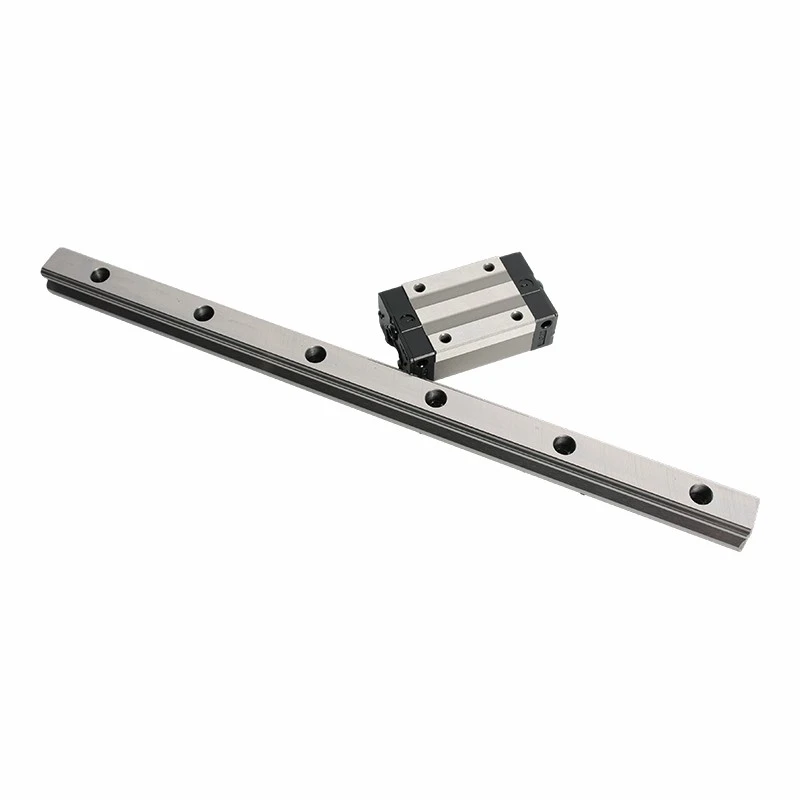

To address this issue, we need to use special lubricants that have better adhesion properties. Some lubricants are designed to stick to the surfaces even in vertical applications, ensuring continuous lubrication. We also have to set up regular maintenance schedules to check and replenish the lubricant as needed.
3. Backlash and Precision
Backlash is a major concern in any linear motion system, but it becomes even more critical in vertical applications. Backlash refers to the small amount of play or clearance between the moving parts of the rail and slider. In a vertical setup, this backlash can cause the load to move slightly when there's a change in direction, leading to inaccurate positioning.
Let's say you're using a Micro Linear Rail in a 3D printer for vertical layer - by - layer printing. If there's too much backlash, the layers might not align properly, resulting in a poorly printed object. To minimize backlash, we often have to use pre - loaded sliders or adjust the clearances between the rail and the slider during installation.
However, achieving the right balance is tricky. If we pre - load the slider too much, it can increase the friction and make the movement less smooth. On the other hand, if the pre - load is too little, the backlash problem won't be solved.
4. Installation and Alignment
Installing and aligning Micro Linear Rail for vertical motion is also a lot more challenging than for horizontal motion. In a vertical setup, even a slight misalignment can cause uneven loading on the rail and slider, leading to premature wear and inaccurate motion.
When installing a vertical Micro Linear Rail, we need to ensure that it's perfectly straight and plumb. This often requires the use of precision tools and careful measurement. For example, we might use a laser alignment system to make sure that the rail is aligned within a very small tolerance.
If the installation isn't done correctly, the rail might bind or the slider might not move smoothly. This can not only affect the performance of the system but also lead to increased energy consumption as the motor has to work harder to overcome the resistance.
5. Environmental Factors
Environmental factors can also have a significant impact on the performance of Micro Linear Rail in vertical applications. For instance, in a dusty or dirty environment, the dust particles can easily get into the rail and slider, causing abrasion and reducing the lifespan of the component.
In a humid environment, there's a risk of corrosion, especially if the rail isn't made of corrosion - resistant materials. And if the temperature changes significantly, the expansion and contraction of the materials can affect the alignment and performance of the rail.
To deal with these environmental challenges, we might need to use protective covers or enclosures to keep the dust out. For corrosion - prone environments, we can choose rails made of stainless steel or other corrosion - resistant materials. And for applications with large temperature variations, we need to select materials with low thermal expansion coefficients.
Wrapping Up and Reaching Out
So, as you can see, using Micro Linear Rail for vertical linear motion comes with its fair share of challenges. But don't let that scare you off! With the right selection of components, proper installation, and regular maintenance, these challenges can be overcome.
If you're in the market for high - quality Micro Linear Rail or have any questions about how to deal with the challenges I've mentioned, I'd love to have a chat. Whether you're working on a small DIY project or a large - scale industrial application, our team of experts can help you find the perfect solution. Just reach out, and we'll start the conversation about how we can meet your specific needs.
References
- "Linear Motion Technology Handbook", Industry Press
- "Advanced Guide Rail Systems: Design and Applications", Academic Journal of Mechanical Engineering