

Hey there! As a supplier of linear block products, I've seen firsthand how crucial it is to improve the performance of linear block codes in noisy environments. In this blog, I'll share some practical tips and insights to help you achieve just that.
Understanding the Challenges in Noisy Environments
First off, let's talk about why noisy environments pose such a big challenge for linear block codes. Noise can come from various sources, like electrical interference, radio frequency interference, or even just natural background noise. When this noise gets mixed in with the signal carrying the linear block code, it can cause errors in the data transmission. These errors can lead to all sorts of problems, from minor glitches to major system failures.
For example, in a manufacturing setting where linear block codes are used to control the movement of machinery, a single error in the code can result in misaligned parts or even damage to the equipment. So, finding ways to improve the performance of these codes in noisy environments is super important.
Tips to Improve Performance
Error Correction Codes
One of the most effective ways to deal with noise is by using error correction codes. These are special algorithms that can detect and correct errors in the data. There are different types of error correction codes, like Hamming codes and Reed - Solomon codes.
Hamming codes are relatively simple and can correct single - bit errors. They work by adding extra parity bits to the original data. These parity bits are calculated based on the values of the data bits, and they can be used to identify and correct errors. Reed - Solomon codes, on the other hand, are more powerful and can correct multiple - bit errors. They are widely used in applications where high - reliability data transmission is required, such as in satellite communication.
Signal Strengthening
Another way to improve the performance of linear block codes in noisy environments is to strengthen the signal. This can be done by increasing the power of the transmitter. A stronger signal is more likely to overcome the noise and reach the receiver without significant degradation.
However, increasing the power has its limitations. It can consume more energy, and in some cases, it may also cause interference with other devices. So, it's important to find a balance between signal strength and power consumption.
Filtering
Filtering is also a great technique to reduce the impact of noise. There are different types of filters, such as low - pass filters, high - pass filters, and band - pass filters. Low - pass filters allow low - frequency signals to pass through while blocking high - frequency noise. High - pass filters do the opposite, allowing high - frequency signals and blocking low - frequency noise. Band - pass filters only allow signals within a specific frequency range to pass through.
By choosing the right filter for your application, you can effectively reduce the noise and improve the performance of the linear block codes.
Our Linear Block Products
As a linear block supplier, we offer a wide range of products that are designed to perform well in various environments, including noisy ones. Our Linear Guide Rail Block is a high - quality product that provides smooth and precise linear motion. It is made with durable materials and is resistant to wear and tear, making it suitable for long - term use in industrial settings.
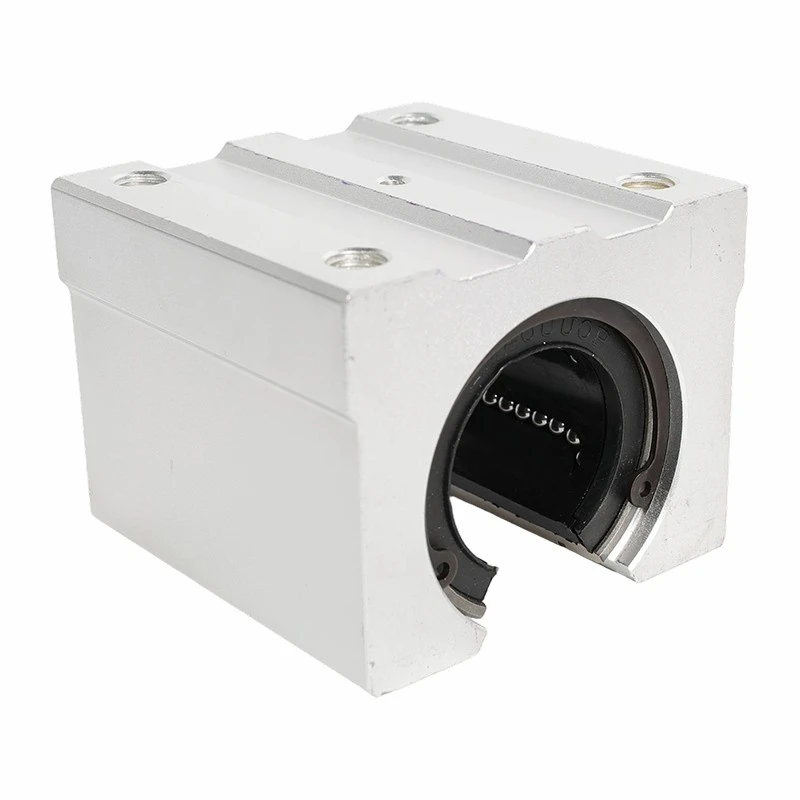

We also have the TBR - UU and SCS - UU linear ball - bearing slide blocks. These blocks are designed to provide low - friction movement and high load - carrying capacity. They are ideal for applications where precision and reliability are crucial.
How Our Products Can Help
Our linear block products are engineered to be robust and reliable, even in noisy environments. The design of our products helps to minimize the impact of noise on the performance of the linear block codes. For example, the high - quality bearings in our slide blocks reduce the vibrations that can cause signal interference.
In addition, our products are easy to install and maintain. This means that you can quickly get your systems up and running, and you won't have to spend a lot of time and money on maintenance.
Conclusion
Improving the performance of linear block codes in noisy environments is a challenging but achievable goal. By using techniques like error correction codes, signal strengthening, and filtering, you can significantly reduce the impact of noise on your data transmission. And as a linear block supplier, we're here to help you with high - quality products that are designed to perform well in these challenging environments.
If you're interested in learning more about our products or have any questions about improving the performance of linear block codes, feel free to reach out to us for a procurement discussion. We're always happy to help you find the best solutions for your needs.
References
- Lin, S., & Costello, D. J. (2004). Error Control Coding: Fundamentals and Applications. Pearson Prentice Hall.
- Wicker, S. B. (1995). Error Control Systems for Digital Communication and Storage. Prentice Hall.